
Pool Filter Installation in Lake Havasu City, AZ
Pool filter installation and replacement in Lake Havasu City. Cartridge, DE and sand filters sized to your pump and your dust load. Plumbed with unions and a gauge, then started up with a recorded clean pressure.

Schedule Service!
Pool filter installation sized for Lake Havasu City dust and pumps
Most filters in Havasu are the wrong size. Nobody chose badly. The pool builder picked the smallest tank that met the flow number, and then the pump got upsized twice over the years. A filter sized that way in our dust runs loaded all summer. The gauge climbs within weeks of each cleaning. Laterals and grids break under the pressure, and the pool clouds after every storm. A new filter is the one chance to fix that. We size the tank to the pump and the dust, not to the catalog minimum.
JM Pool Service installs and replaces pool filters across Lake Havasu City on the same route that cleans and repairs them. We fit cartridge, DE and sand tanks from Pentair, Hayward and Jandy. Each one gets unions so the next service does not need a saw, a new pressure gauge with air relief, and a clean baseline pressure written on the tank. When a filter replacement happens with a pump replacement, the two get sized together. That is the only way the math works.
This page covers what a pool filter installation includes here and how we size and choose between the three filter types. It also covers the signs a tank is due for replacement rather than repair, and why size matters more in Havasu than anywhere. Cost is in the FAQs at the bottom. Every new pool filter gets quoted after a site visit, with the pump’s horsepower and the pool’s volume written in the quote.
Need pool service? Get in touch with us and schedule your FREE pool service quote from JM Pool Service
We Are Experts With:




What a pool filter installation includes in Lake Havasu City
Five steps, and the first one is arithmetic. A filter that is right for the pump and the pool needs no heroics later. A filter that is wrong gets cleaned every six weeks for the rest of its life.
Sizing the filter to the pump, not the pool
Filter size is a flow number. A 20,000-gallon pool turned over in eight hours needs about 42 gallons a minute through the filter. Each media type has a flow it can handle per square foot. High-rate sand runs 15 to 20 gallons a minute per square foot. Diatomaceous earth runs about 2. Cartridge runs about 0.375, which is why cartridges have so much more area. Divide the flow by that rate and you get the minimum filter area. For that 20,000-gallon pool, a cartridge needs at least 112 square feet. In Havasu we go up to 150 or 200 so the cycles run long. The pump’s actual output, not its label, is the number we size against.
Pool filter sizing when the pump is variable-speed
Variable-speed pumps change the pool filter sizing question in a useful way. At full speed a modern variable-speed pump often moves more water than the single-speed it replaced, so the filter has to handle that peak. Most of the day, though, the pump runs slow. Low flow through a large filter is the best filtration a pool can get.
Water moves gently through the media, fine dust settles into the pleats or the cake instead of punching through, and the gauge barely moves. So we size the filter for the pump’s top speed, then program the pump to spend most of its hours well below it. Owners who do this see cleaning intervals stretch from six weeks to four months or more.
Skip the step and a new variable-speed pump on an old small filter runs loud, hot and high on the gauge. The pump’s control panel also lets us set a cleaning-mode speed, a short daily burst at full flow that lifts settled dust off the floor and into the filter. That only works when the filter has the area to take it. On an undersized tank, the burst just drives the gauge up and shortens the cycle.
Choosing cartridge, DE or sand for a Havasu pool
Each media catches a different size of dirt. Sand stops particles down to about 25 microns, cartridge 10 to 25, DE 2 to 6. DE gives the sharpest water and needs the most careful handling. The powder is a respiratory hazard, and the grids need recoating after every backwash. Sand is the simplest and uses the most water. Every backwash sends a few hundred gallons to waste.
Cartridge uses no backwash water at all, which matters in a desert town. It handles fine dust well as long as the tank is big enough. Most Havasu replacements end up as a large cartridge. DE suits owners who want the clearest water. Sand suits pools where the owner wants to turn a handle and walk away.
Plumbing, valves and the pressure gauge
The tank sits on a level pad with room to open the lid and lift the cartridge or grids straight up. Unions go on both sides so the filter comes out without cutting pipe. Sand and DE tanks get a multiport or push-pull valve, with the waste line run to where backwash water can go. A new pressure gauge and air relief go on top. One rule we never bend: chemical feeders go after the filter and the heater, never before. A chlorinator upstream of a filter attacks the media and the tank. We see it on half the pads we replace.
Start-up: fresh media and the clean pressure
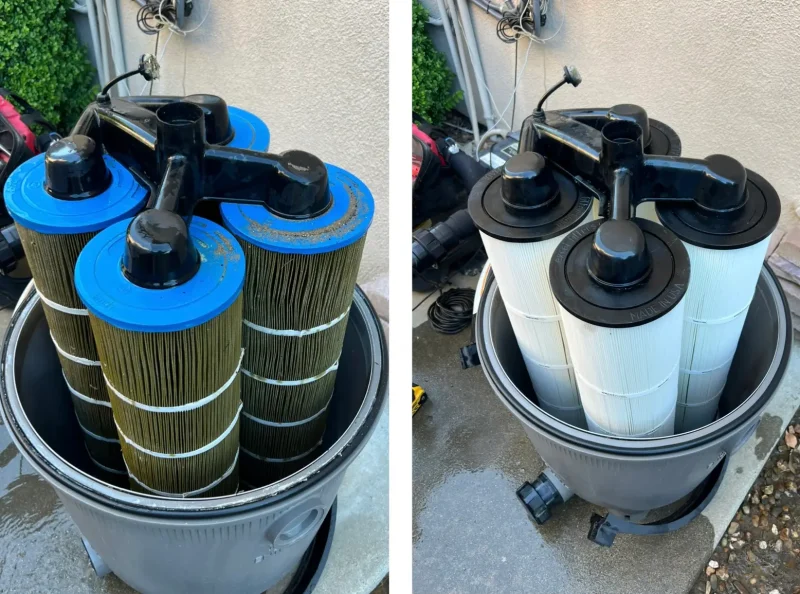
Each media starts differently. Sand goes in over water to protect the laterals, then gets backwashed and rinsed until the sight glass runs clear. DE grids get seated, then a precoat of 1 to 1.5 pounds of powder per 10 square feet goes in through the skimmer with the pump running. Too little precoat and oils clog the cloth. Too much and the cake bridges between grids. A cartridge element seats on the standpipe, and the lid O-ring gets a coat of silicone. Then the pump runs, the air bleeds, and we write the clean pressure on the tank. That number is the baseline for every cleaning and repair decision afterward.
Pool filter replacement versus repair
Not every failing filter needs replacing. A cracked lid, a stretched clamp band, a torn grid, a broken lateral or a dead gauge is a part. Parts are on our pool filter repair page. The tank is due for replacement when the body itself is cracked or the valve and grids are discontinued. It is also due when the tank was undersized from the start and has been breaking parts to prove it. Dead sand is a sand change, not a new tank, and that is on our pool filter sand changes page.
When a Lake Havasu City pool needs a new filter
The gauge usually says it first. When the clean pressure right after a cleaning has crept up year over year, the media is tired or the tank is too small. A filter that needs a cleaning every six weeks even in winter is too small. And when the same part breaks twice, the pump is pushing more than the tank can take. A cracked tank body is an immediate replacement, because a pressure vessel with a crack does not fail gently. Past fifteen Havasu summers, lids, bands and gauges all fail at once. That is when a new tank costs less than the string of repairs.
Replacement also makes sense when the pump changes. A new variable-speed pump can push more flow at full speed than an old single-speed. A filter sized for the old pump chokes it. We size the pair together on our pool pump replacement page. Under federal pool safety rules the drain covers have a flow rating too, so pump and filter changes get checked against it.
Why filter size matters more in Lake Havasu City
Dust is the first reason. A monsoon haboob drops more solids into a pool in one afternoon than a month of normal use. A small filter takes that load and hits its cleaning pressure within days. The large one absorbs it and keeps running. Twice the filter area roughly doubles the time between cleanings. In Havasu that is the difference between two cleanings a year and six.
Pump pressure is the second. High velocity through the media drives dirt deep into cartridge pleats and DE cloth where cleaning never reaches it. In sand, it carves channels. A bigger filter lowers the velocity for the same pump. A slower variable-speed pump lowers it further, and the Department of Energy puts the power saving of running slower at up to 75 percent. Filter and pump are one system. Size one without the other and the pad ends up with a filter that breaks laterals every spring.
Heat is the third. Tank plastic, lids and clamp bands sit in 115-degree sun for four months a year, and the hotter a tank runs the sooner it fatigues. A filter that runs at 25 psi all summer ages faster than one that idles at 10. Oversizing is not a luxury here. It is how a tank reaches fifteen years instead of eight.
Who installs your filter in Lake Havasu City
The same JM Pool Service tech who cleans and repairs filters on the weekly route. One insured person who has opened enough Havasu tanks to know which lid cracks first and which valve seizes with calcium. The tech has seen your pad every week. So the new filter gets sized to the pump that is really there and the dust your yard really gets. When a repair would carry the old tank another five years, you hear that. When the tank is done, you get a replacement quote with the filter area and the pump output written on it. The rest of the pad is on our pool equipment installations page.
Pool filter installation service areas around Lake Havasu City
Our pool filter installation covers Lake Havasu City and about fifteen miles around it. That means the Island District, Downtown, Southside, Southgate, Acoma and Kiowa-Amberwood. It also means Vista Del Sol, Village Parc, the Medical District, the Refuge, North Pointe and out toward the Foothills. If you searched “pool filter installation near me” from anywhere in Havasu, this is the route. The full list is on our pool service area page.
Filter installation is one part of our pool equipment installations work. Pool filter cleaning keeps the new tank running long cycles. Weekly pool service reads the gauge every visit so the baseline means something.
Our Service Areas
- Lake Havasu City
- Acoma
- Downtown Lake Havasu
- Beachcomber Resort
- Kiowa-Amberwood
- Southside
- Village Parc
- Vista Del Sol
- Southgate
- Island District
- Casa De Agua Azul
- Medical District
Pool filter installation FAQs for Lake Havasu City
What Havasu pool owners ask Google about new filters, and what they ask each other on the community page.
Replacing a pool filter system starts with sizing a new tank to the pump's flow and the pool's volume. Then the pump goes off, the old tank comes out at the unions or pipe, and the new tank sets level. It gets plumbed with unions and a valve where needed. Media goes in, the pump starts, the air bleeds, and the clean pressure gets recorded. In Lake Havasu City the sizing step matters most, because dust loads filters fast. JM Pool Service handles the whole job in a visit and sizes up for the dust.
Pool filter replacement in Lake Havasu City is quoted per pad after a site visit. Tank type, filter area, the valve and any plumbing changes all move the number. A sand tank costs the least to buy and the most in water. Large cartridges cost more up front and nothing in backwash water. DE tanks with a valve sit at the top. JM Pool Service gives you the filter area and the pump output with every quote, so the size is justified rather than guessed.
For most Lake Havasu City pools a large cartridge filter is the best choice. It catches dust down to 10 to 25 microns, uses no backwash water, and sizes up easily for long cycles. DE filters give the clearest water at 2 to 6 microns but need recoating and careful powder handling. Sand filters are simple and durable. They use hundreds of gallons per backwash and catch only to about 25 microns. JM Pool Service recommends by pump size, dust exposure and how hands-on the owner wants to be.
Pool filter size comes from flow, not from pool volume alone. Divide pool gallons by the turnover time in minutes to get gallons per minute. Then divide that by the media's flow rate per square foot: about 15 to 20 for sand, 2 for DE, 0.375 for cartridge. A 20,000-gallon pool on an eight-hour turnover needs about 42 gallons a minute. That means at least 112 square feet of cartridge. In Lake Havasu City JM Pool Service sizes one step larger than the minimum so dust does not shorten the cycles.
A new pool filter tank lasts 10 to 15 years in Lake Havasu City. UV and heat age the plastic faster here than in milder climates. The media inside wears sooner: cartridges two to three years, DE grids five to eight, sand three to five. Lids, clamp bands, gauges and O-rings are wear items. JM Pool Service replaces those as parts, so the tank reaches its full life instead of being swapped for a cracked lid.
Yes. In Lake Havasu City upsizing a pool filter at replacement is almost always worth it. A larger filter area lowers the water velocity through the media, so dust does not embed and the pressure climbs more slowly. Twice the area roughly doubles the time between cleanings. The only limits are pad space and the pump's flow, which JM Pool Service measures before quoting. A filter cannot be too big for a pump, but a pump can be too big for a filter.
Yes. Switching from DE or sand to a cartridge filter is a common replacement in Lake Havasu City. A cartridge needs no backwash water and no powder. The change needs the backwash valve removed or capped, the plumbing re-run with unions, and a cartridge tank large enough for the pump's flow. Owners who switch usually gain longer cycles and lose the weekly backwash chore. JM Pool Service sizes the cartridge against the pump and handles the valve removal in the same visit.
The filter has to match the pump's flow, not its brand. A filter rated below the pump's output runs at high pressure, breaks laterals and grids, and clouds the pool. Brands can mix, since the plumbing is standard PVC. In Lake Havasu City a like-for-like filter swap on existing plumbing generally does not need a permit. Electrical work for a new pump does. JM Pool Service checks the pump's output and the drain cover flow rating before quoting any filter.
All three major brands make reliable tanks. In Lake Havasu City the right one is usually the brand whose cartridges and parts the local shops stock, so a replacement cartridge is never a two-week wait. Pentair and Hayward cartridge tanks dominate Havasu pads for that reason. JM Pool Service carries parts for all three and recommends by size and parts availability first, brand second.
A pool filter cannot be too big for a pump in any way that hurts the pool. A larger filter runs at lower pressure, cleans less often and lasts longer. The only costs are pad space and purchase price. The reverse is the problem. A pump too large for the filter drives dirt into the media and breaks internals. In Lake Havasu City, where dust loads filters fast, JM Pool Service treats the catalog minimum as the floor and sizes up from there.
Still have questions?